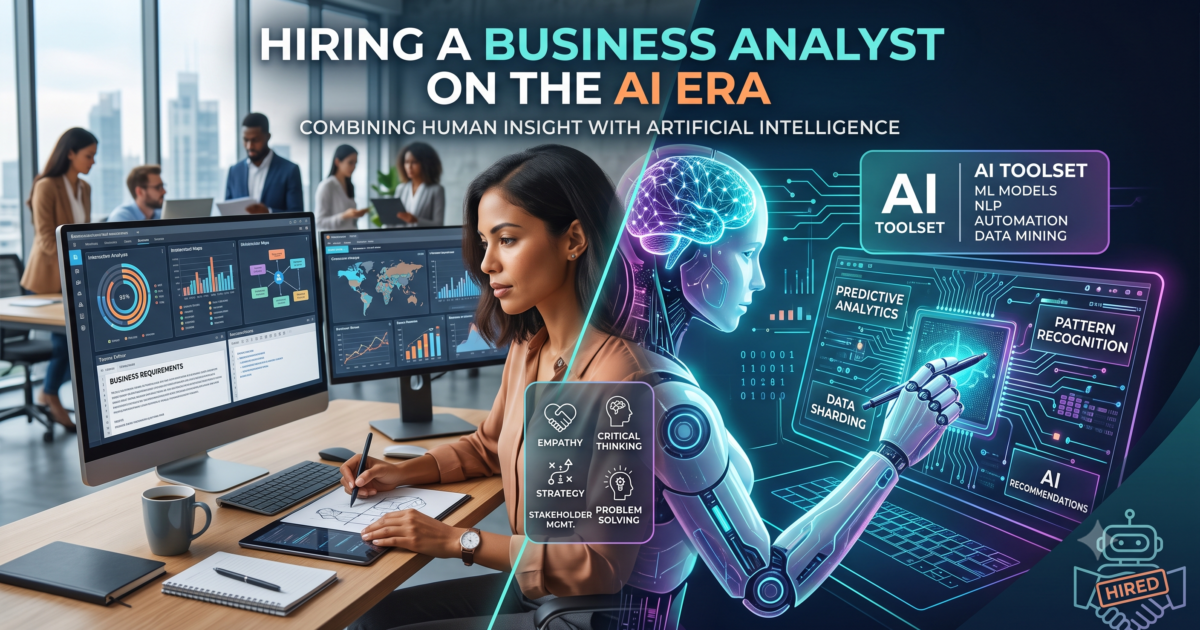
There is a growing misconception that AI will replace business analysts. I believe the opposite. After more than 20 years delivering software projects, I would argue that experienced business analysts have never been more valuable. What is changing is not whether companies need business analysts, but what makes a great one.
AI can summarize meetings, generate user stories, create process diagrams, and even suggest acceptance criteria. Those are useful capabilities, but they represent only a fraction of what good business analysis is about. The difficult part has never been documenting requirements. The difficult part is discovering the right problem to solve. That still requires people.
The Business Analyst Was Never Just a Requirements Writer
For years, many organizations reduced business analysis to documentation, interview stakeholders, write requirements, create user stories, hand everything over to development. That model produced thousands of pages of documentation that quickly became outdated and often failed to solve the underlying business problem.
The strongest analysts I’ve worked with rarely started by asking:
“What features do you need?”
Instead, they asked:
- “Why does this process exist?”
- “What problem are we trying to solve?”
- “Who actually benefits from this?”
- “What happens if we remove this step entirely?”
Those questions often uncover issues nobody initially recognized. Good business analysts challenge assumptions. Great business analysts challenge the problem itself.
AI Changes the Work—Not the Role
Large language models have already automated many repetitive analysis tasks. Today, AI can help produce:
- User stories
- Acceptance criteria
- Process documentation
- Meeting summaries
- Functional specifications
- SQL queries
- API documentation
- Test scenarios
These tasks are becoming commodities. The differentiator is no longer producing documentation quickly. It is knowing whether the documentation describes the right solution. AI has no organizational context. It does not understand politics between departments, it cannot detect when stakeholders contradict each other, it cannot tell when people describe symptoms instead of causes. An experienced analyst can. The value of business analysis is moving higher up the decision chain.
The Best Analysts Translate Between Worlds
One misconception persists in hiring. Companies often look for analysts with deep technical expertise or extensive domain knowledge. Those are valuable. But neither is the defining skill. The best analysts are translators. They understand enough technology to speak with developers. They understand enough business to challenge stakeholders. Most importantly, they can translate between both groups without losing meaning. Developers think in systems, business leaders think in outcomes, customers think in experiences. A good analyst connects all three perspectives. That ability is surprisingly rare.
What I Look For During Interviews
I dislike interviews that focus on memorization. Whether it is a Leetcode exercise for developers or textbook BABOK questions for analysts, they reveal very little about how someone will perform on a real project. Instead, I prefer discussion. I present a realistic business problem.
For example:
A growing logistics company receives increasing customer complaints about delivery delays. Management wants a completely new customer portal. Then I simply ask:
“Where do you start?”
There is no perfect answer. What matters is the thinking. Strong analysts begin asking questions. Weak analysts begin proposing solutions. That difference tells me almost everything I need to know.
The Signals That Matter
When hiring business analysts, I consistently look for four qualities.
1. Curiosity
Curious analysts keep asking “why.” Not to challenge authority. To uncover assumptions. Surface-level requirements rarely describe the real problem. Curiosity exposes what stakeholders often overlook.
2. Systems Thinking
Business processes rarely exist in isolation. Changing one workflow often affects five others. Good analysts naturally think in dependencies:
- What breaks?
- Who owns this?
- Which systems are connected?
- What happens six months from now?
This type of thinking becomes even more important as organizations adopt AI across multiple departments.
3. Communication
Analysis is communication. If an analyst cannot explain complex ideas simply, misunderstandings multiply. The strongest analysts adapt naturally. Executives receive business language. Developers receive technical precision. Users receive clarity. Everyone leaves with the same understanding.
4. Decision-Making
Analysis is not passive documentation, it requires judgment. Sometimes requirements conflict, sometimes stakeholders disagree, sometimes budgets eliminate ideal solutions. Experienced analysts make recommendations rather than simply recording every opinion.
The Biggest Hiring Mistake
Many organizations still recruit analysts using keyword checklists:
Five years of experience.
- BABOK certification.
- BPMN
- UML
- JIRA
- SQL
- Agile
None of these guarantee effective business analysis. I’ve worked with certified analysts who documented everything but understood very little. I’ve also worked with analysts who had no formal certification yet consistently delivered exceptional outcomes because they understood people, systems, and business priorities. Frameworks can be learned but critical thinking is much harder to teach.
AI Makes Human Skills More Valuable
As AI becomes part of everyday software delivery, the importance of uniquely human skills increases. Future business analysts will spend less time writing documents. They will spend more time:
- Facilitating workshops
- Challenging assumptions
- Evaluating AI-generated outputs
- Designing business processes
- Defining governance
- Aligning technology with business strategy
The role is becoming more strategic. Organizations that continue hiring analysts primarily as documentation specialists will increasingly find themselves competing with software. Organizations that hire analytical thinkers will gain something AI still struggles to provide: sound judgment.
Hiring for the Next Decade
The best business analysts don’t create documents, they create clarity. They reduce uncertainty before development begins, prevent expensive misunderstandings, identify problems that nobody realized existed, and increasingly, they become the people who determine how AI should be used—not simply where it can be used.
If I were hiring a business analyst today, I would care far less about whether they can produce perfect user stories. I would care whether they can walk into a room with conflicting opinions, incomplete information, and unclear objectives—and leave with a shared understanding of the real problem. Because that remains one of the highest-value skills in software development.
AI may generate requirements in seconds, but it still cannot replace good judgment
Ready to Transform Your Business?
Let's discuss how Skaldron can help bring your vision to life with our expert IT development services.
Get Started