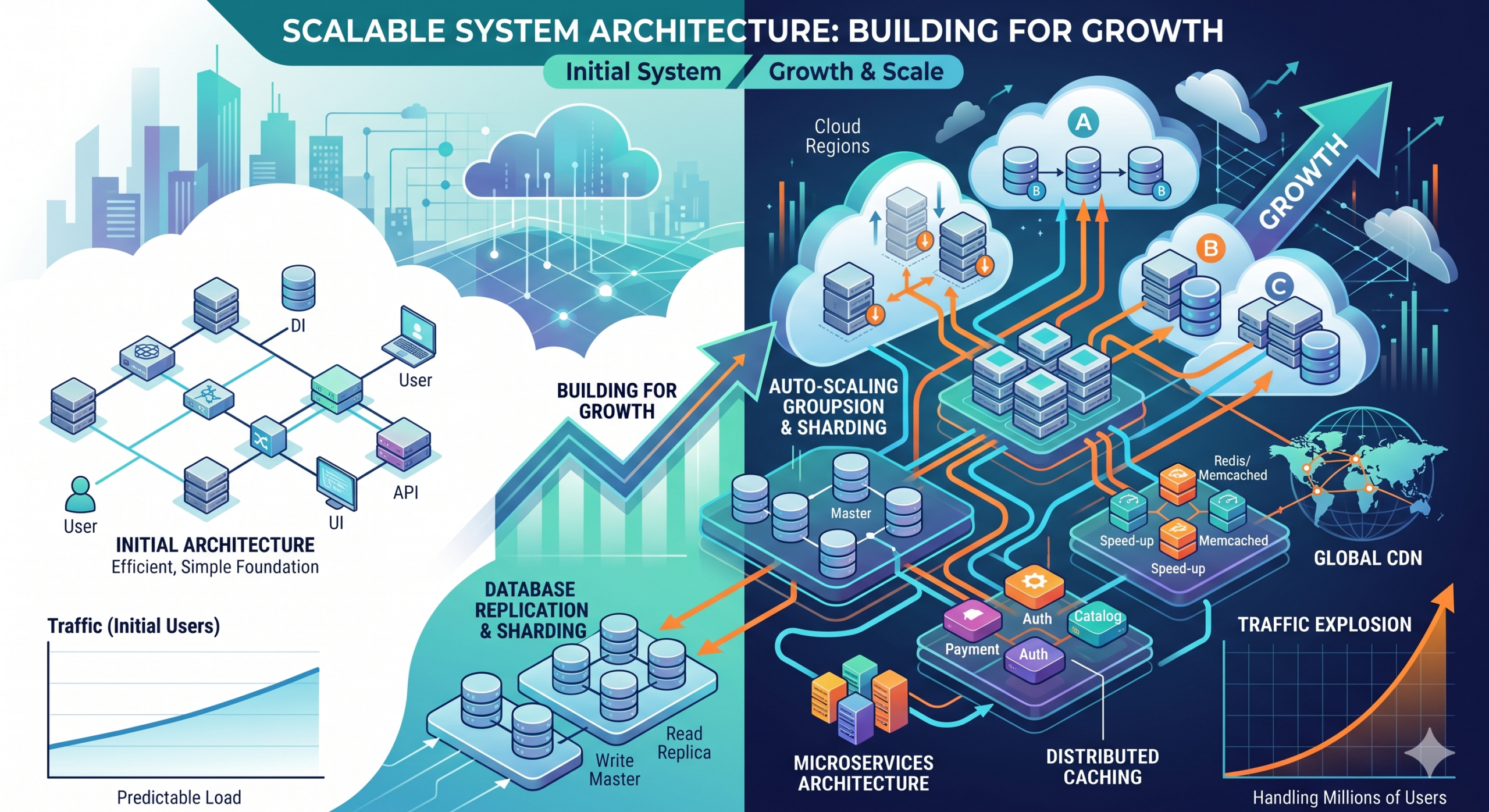
Modern software systems rarely fail because of a lack of features. More often, they fail because they cannot handle success.
A product launches quickly, gains traction, traffic increases, integrations multiply, and suddenly the architecture that worked perfectly for a few thousand users begins to struggle under real-world pressure. Performance degrades, deployments become risky, outages become frequent, and development slows to a crawl.
Scalability is no longer a concern reserved for global technology giants. Any digital product with ambitions for growth must be designed with scale in mind from the beginning.
At its core, scalable system architecture is not about building the most complex infrastructure possible. It is about creating systems that can evolve predictably, maintain reliability under increasing demand, and support business growth without constant rewrites.
The Real Cost of Poor Architecture
Technical debt is often misunderstood as messy code. In reality, it is usually architectural.
A system built without scalability considerations may initially appear efficient. Development moves fast, infrastructure costs stay low, and teams focus entirely on delivering features. The problems emerge later — often when growth is already happening.
What works for 1,000 users may completely collapse at 100,000.
Databases become bottlenecks. APIs start timing out. Deployment windows grow longer. Small changes create unintended side effects across unrelated parts of the system. Teams begin spending more time firefighting than building.
The most painful part is that rearchitecting a live production system is significantly more expensive than designing properly from the start. Once customers, integrations, and business operations depend on the platform, architectural mistakes become deeply embedded into daily operations.
Scalable system architecture is therefore not an engineering luxury. It is a business continuity strategy.
Scalability Is About More Than Traffic
Many organizations associate scalability purely with server load or user volume. In reality, true scalability spans several dimensions simultaneously:
- Traffic scalability — handling increasing numbers of users and requests
- Data scalability — managing rapidly growing datasets efficiently
- Operational scalability — maintaining reliability as infrastructure expands
- Development scalability — enabling teams to work independently without constant conflicts
- Business scalability — adapting systems to support new products, markets, and integrations
A technically scalable system that slows down development teams is still poorly designed. Likewise, a perfectly optimized backend that cannot adapt to changing business models eventually becomes a liability.
The goal is sustainable growth across both technology and operations.
Horizontal Scaling: The Foundation of Modern Systems
One of the most important principles in scalable system architecture is designing systems that scale horizontally.
Vertical scaling — adding more CPU, RAM, or storage to a single server — works only up to a point. Eventually, hardware limits, costs, and single points of failure become serious risks.
Horizontal scaling approaches the problem differently: instead of making one machine larger, the system distributes load across multiple machines.
This is the foundation behind modern cloud-native systems.
Key architectural patterns that enable horizontal scaling include:
- Stateless application services
- Load balancing across instances
- Distributed caching layers
- Container orchestration platforms
- Message queues and asynchronous processing
- Distributed storage systems
Stateless services are particularly important because they allow requests to be processed by any available instance. This creates flexibility, resilience, and the ability to scale dynamically during peak demand.
The cloud accelerated this shift dramatically. Infrastructure is no longer static. Modern systems are expected to scale automatically based on demand patterns, often within seconds.
The Microservices Debate: Complexity vs Flexibility
Few architectural topics generate more debate than microservices.
For years, microservices were treated as the default destination for any “serious” platform. In practice, many organizations adopted them far too early and introduced enormous operational complexity without solving actual business problems.
Microservices are not automatically better architecture.
For many companies, a well-structured monolith remains the most efficient approach for years.
A modular monolith can provide:
- Faster development cycles
- Simpler deployments
- Easier debugging
- Lower operational overhead
- Better transactional consistency
- Reduced infrastructure complexity
Microservices become valuable when specific scaling or organizational challenges emerge:
- Independent team ownership
- Highly uneven scaling requirements
- Large and complex domains
- Strict fault isolation needs
- Independent deployment requirements
- Technology diversification
The transition should happen because complexity demands it — not because the industry trend suggests it.
Many successful platforms began as monoliths and evolved gradually over time. Premature distribution often creates more problems than it solves.
Good architecture is not about following fashionable patterns. It is about choosing the right level of complexity for the business stage.
Database Strategy Shapes Scalability
Databases remain one of the most critical scalability decisions in any system.
A common architectural mistake is selecting databases based solely on team familiarity rather than access patterns and workload characteristics.
Different databases solve fundamentally different problems.
Relational databases remain exceptionally powerful for:
- Structured business data
- Strong consistency requirements
- Complex querying
- Financial transactions
- Reporting workloads
Document databases excel in scenarios involving:
- Flexible schemas
- Rapid iteration
- Content-heavy applications
- Semi-structured datasets
Key-value stores and distributed caches are optimized for:
- Ultra-fast reads
- Session storage
- Temporary data
- High-throughput workloads
Modern scalable systems rarely rely on a single database technology. Instead, they use polyglot persistence — selecting storage technologies based on specific service requirements.
Equally important is understanding that scaling databases is often far more difficult than scaling application servers.
Read replicas, partitioning, caching strategies, indexing optimization, and eventual consistency models all become critical at scale.
Architecture decisions made early around data ownership and access patterns can determine whether future growth becomes manageable or painful.
Resilience Matters as Much as Performance
Scalability without resilience creates fragile systems.
Modern architectures must assume failure will happen:
- Servers fail
- Networks partition
- Third-party services become unavailable
- Traffic spikes unexpectedly
- Deployments introduce bugs
Scalable systems are designed to degrade gracefully rather than fail catastrophically.
This requires architectural patterns such as:
- Circuit breakers
- Retry mechanisms
- Queue-based processing
- Redundancy across regions
- Observability and monitoring
- Automated recovery processes
Reliability engineering is no longer separate from software architecture. The two disciplines are deeply connected.
The strongest architectures are often not the fastest systems, but the ones that remain operational during unpredictable conditions.
Observability Is a Core Architectural Layer
As systems grow, visibility becomes essential.
In small applications, debugging can often happen directly through logs or local testing. At scale, distributed systems become impossible to manage without proper observability.
Modern scalable architectures rely heavily on:
- Centralized logging
- Metrics collection
- Distributed tracing
- Real-time alerting
- Performance analytics
Observability is what allows engineering teams to understand system behavior under real production conditions.
Without it, scalability problems become guesswork.
This is especially important in distributed environments where a single user request may travel through dozens of services before completion.
Organizations that invest early in observability typically scale far more effectively because they identify bottlenecks before they become outages.
AI, Edge Computing, and the Next Architecture Shift
The next major evolution in scalable architecture is already underway.
AI workloads, real-time personalization, and edge computing are fundamentally changing infrastructure design requirements.
Traditional centralized architectures are increasingly being supplemented by:
- Edge processing closer to users
- Event-driven systems
- GPU-intensive compute layers
- AI inference services
- Streaming architectures
- Real-time analytics pipelines
Latency expectations are shrinking while data volumes continue exploding.
At the same time, sustainability and infrastructure efficiency are becoming more important business considerations. Architectural decisions increasingly affect not only performance, but also operational cost and energy consumption.
The future of scalable systems will likely emphasize intelligent orchestration, adaptive infrastructure, and highly distributed processing models.
The organizations that prepare for this shift early will gain significant operational advantages.
Building for the Future
Scalable system architecture is ultimately about creating systems that support long-term business evolution.
The best architectures are rarely the most complicated. They are the ones that balance performance, simplicity, reliability, operational efficiency, and future adaptability.
Technology stacks will evolve. Infrastructure platforms will change. Traffic patterns will shift. Business models will adapt.
Strong architecture creates the foundation that allows organizations to evolve without rebuilding everything from scratch.
At Skaldron, scalable architecture is approached as both a technical and strategic discipline. Systems are designed not only for today’s requirements, but for the operational realities businesses will face as they grow — ensuring reliability, flexibility, and sustainable scalability long after the initial launch.
Ready to Transform Your Business?
Let's discuss how Skaldron can help bring your vision to life with our expert IT development services.
Get Started